Car Detailing Pricing Guide: How Much to Charge in 2026
Complete car detailing pricing guide for 2026. Learn how much to charge for interior, exterior, paint correction, and ceramic coating services by vehicle type and region.
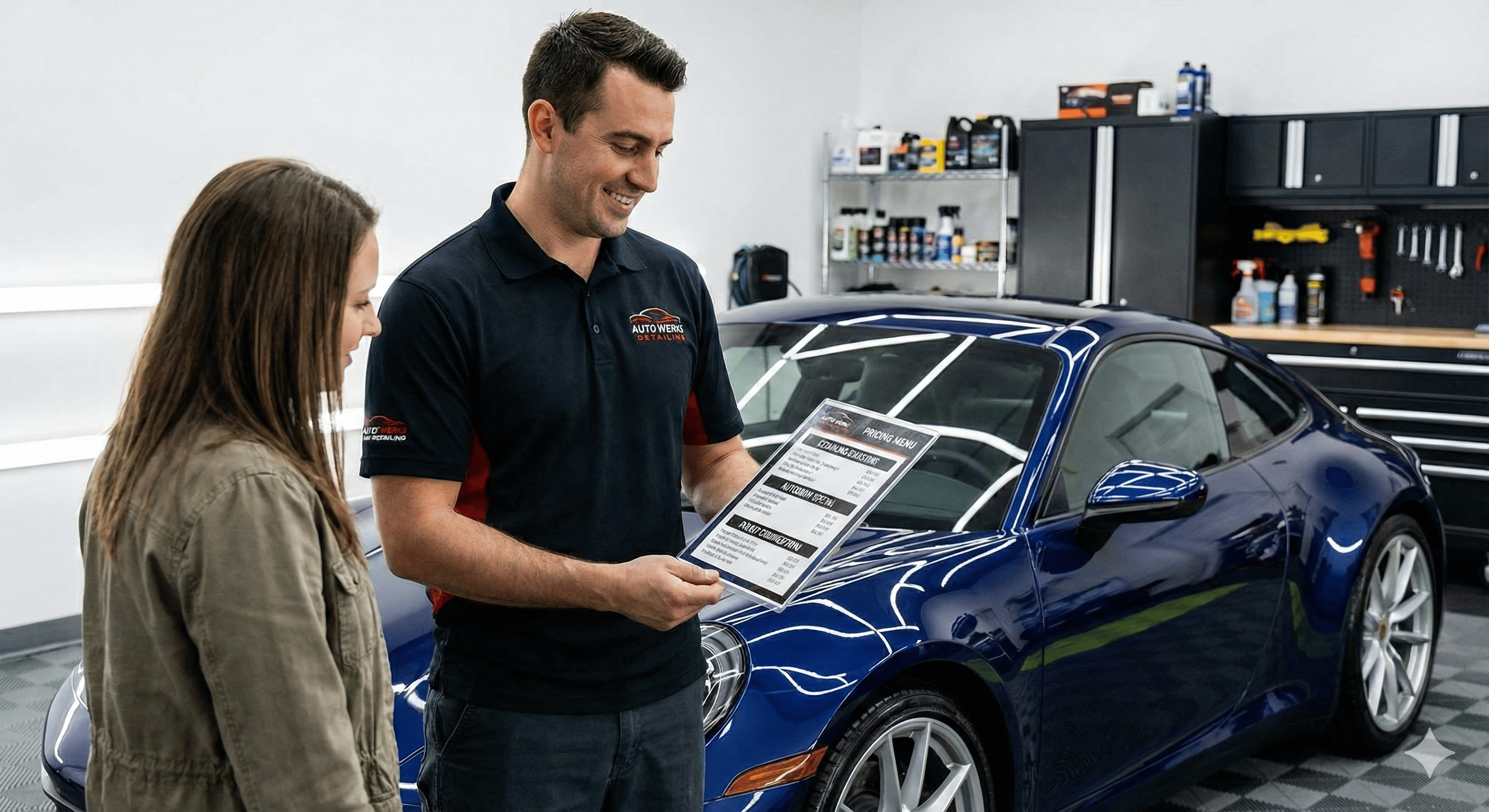
Pricing is the single biggest lever in your detailing business. Get your car detailing pricing right and you'll earn a strong living doing work you enjoy. Get it wrong — too low and you burn out, too high without the reputation to back it up and you won't get bookings.
This guide gives you real-world pricing data for every major detailing service in 2026, broken down by vehicle type, region, and business model. Whether you're starting a new detailing business or re-evaluating your current prices, you'll walk away with a clear pricing strategy you can implement today.
How to Set Your Detailing Prices
Before looking at specific numbers, understand the framework behind smart pricing. Detailers who pick prices out of thin air leave money on the table — or price themselves out of the market.
1. Know Your Costs Per Job
Every job has direct costs you need to cover:
- Products and chemicals: $5–$20 per job (wash soap, APC, dressings, towels)
- Travel time and fuel: $5–$15 per job (mobile detailers)
- Insurance per job: $2–$5 (annual premium divided by job count)
- Equipment wear: $3–$8 per job (pads, towels, tool depreciation)
A typical mobile exterior/interior detail costs you $15–$45 in direct expenses before you pay yourself a dollar.
2. Set Your Hourly Income Target
Work backwards from what you want to earn:
| Annual Income Goal | Jobs/Week | Avg. Hours/Job | Required Hourly Rate |
|---|---|---|---|
| $50,000 | 15 | 2.5 | $55/hr |
| $75,000 | 15 | 2.5 | $80/hr |
| $100,000 | 18 | 2.5 | $85/hr |
| $150,000 | 20 | 3.0 | $100/hr |
These numbers assume 48 working weeks per year with realistic scheduling. Your target hourly rate determines your minimum prices.
3. Research Your Local Market
Check what 5–10 competitors charge in your area:
- Google Maps — search "car detailing near me" and check websites
- Yelp — many detailers list pricing directly
- Instagram — look for local detailing pages that post price menus
- Facebook groups — local community groups often have recommendations
You don't need to match the cheapest competitor. Position yourself based on quality and convenience, not price.
Car Detailing Prices by Service (2026)
Here's what detailing services cost across North America in 2026, based on market data and industry benchmarks from the International Detailing Association.
Exterior Wash and Detail
| Service | Sedan/Coupe | SUV/Crossover | Truck/Van | Duration |
|---|---|---|---|---|
| Basic hand wash + dry | $30–$50 | $40–$65 | $45–$75 | 30–45 min |
| Exterior detail (wash, clay, wax) | $75–$125 | $100–$160 | $120–$180 | 1.5–2.5 hrs |
| Exterior detail + sealant | $100–$150 | $130–$200 | $150–$220 | 2–3 hrs |
Exterior detailing includes a thorough hand wash, decontamination (clay bar or chemical decon), and a protective layer (carnauba wax or synthetic sealant). This is different from a simple car wash — you're selling the deep clean and protection that an automatic wash can't match.
Interior Detailing
| Service | Sedan/Coupe | SUV/Crossover | Truck/Van | Duration |
|---|---|---|---|---|
| Interior vacuum + wipe-down | $40–$60 | $50–$75 | $55–$85 | 30–45 min |
| Full interior detail | $100–$160 | $130–$200 | $150–$230 | 2–3 hrs |
| Interior + steam cleaning | $130–$200 | $170–$250 | $190–$280 | 2.5–4 hrs |
| Interior + odor removal | $150–$220 | $180–$270 | $200–$300 | 3–5 hrs |
Full interior detailing covers vacuuming all surfaces, shampooing carpets and mats, cleaning and conditioning leather or fabric seats, dashboard and console cleaning, door panels, glass, and air vents. The add-ons (steam, odor removal) command premium pricing because they require specialized equipment.
Full Detail Packages
| Service | Sedan/Coupe | SUV/Crossover | Truck/Van | Duration |
|---|---|---|---|---|
| Full detail (int + ext) | $175–$275 | $225–$350 | $250–$400 | 3–5 hrs |
| Full detail + engine bay | $225–$325 | $275–$400 | $300–$450 | 4–6 hrs |
Full detail packages are the bread and butter of most detailing businesses. Bundling interior and exterior at a slight discount (vs. buying separately) increases your average ticket size while giving the customer a better perceived deal.
Pro tip: Always offer a "full detail" package. Customers who only see individual services often pick the cheapest option. A well-presented package at $225–$350 converts better than selling interior and exterior separately.
Paint Correction
| Service | Sedan/Coupe | SUV/Crossover | Truck/Van | Duration |
|---|---|---|---|---|
| 1-step polish (light swirl removal) | $200–$400 | $275–$500 | $300–$550 | 3–5 hrs |
| 2-step correction (compound + polish) | $400–$700 | $500–$900 | $550–$1,000 | 6–10 hrs |
| 3-step correction (wet sand + compound + polish) | $600–$1,200 | $800–$1,500 | $900–$1,800 | 8–14 hrs |
Paint correction is where the real money is. It requires skill, experience, and proper equipment — which justifies the premium pricing. Most detailers don't offer it, so the supply-demand balance works in your favor.
A 2-step correction on a sedan at $500 taking 7 hours = $71/hr. That's solid, but the real payoff comes when you upsell ceramic coating on freshly corrected paint.
Ceramic Coating
| Service | Sedan/Coupe | SUV/Crossover | Truck/Van | Duration |
|---|---|---|---|---|
| Consumer-grade ceramic (1-year) | $300–$600 | $400–$750 | $450–$850 | 4–6 hrs |
| Professional ceramic (3–5 year) | $600–$1,200 | $800–$1,500 | $900–$1,800 | 1–2 days |
| Premium ceramic (5–7 year, multi-layer) | $1,000–$2,000 | $1,200–$2,500 | $1,400–$3,000 | 1.5–2.5 days |
Ceramic coating is the highest-margin service in detailing. The product cost is typically $50–$150 per application, meaning margins of 70–85%. However, pricing includes paint correction prep, which is where most of the labor goes.
Bundle pricing works best here. Offer "Paint Correction + Ceramic Coating" as a package. A 2-step correction ($500) + professional ceramic ($900) sold as a package at $1,200 gives the customer a $200 discount and you a single high-ticket job worth $1,200.
Paint Protection Film (PPF)
| Coverage | Sedan/Coupe | SUV/Crossover | Truck/Van |
|---|---|---|---|
| Partial front (bumper, hood, fenders) | $800–$1,500 | $1,000–$1,800 | $1,200–$2,000 |
| Full front end | $1,500–$2,500 | $1,800–$3,000 | $2,000–$3,500 |
| Full vehicle wrap | $4,000–$7,000 | $5,000–$8,000 | $6,000–$10,000 |
PPF is a specialized service that requires training, a controlled environment (shop), and significant material costs (film = $3–$8/sq ft). If you're starting mobile, PPF likely isn't your first offering — but it's a lucrative growth path.
Want to display your pricing professionally? DetailPilot lets you create a branded booking page with your service menu, pricing tiers, and vehicle type options — so customers can see your prices and book instantly. No more sending price lists over text.
Create your booking page for free →
How Pricing Varies by Region
Car detailing prices differ significantly depending on where you operate. Cost of living, competition density, and customer expectations all play a role.
Regional Price Multipliers (vs. National Average)
| Region | Price Multiplier | Example: Full Detail |
|---|---|---|
| New York City / San Francisco / LA | 1.4x–1.8x | $300–$450 |
| Boston / Seattle / DC / Miami | 1.2x–1.5x | $250–$375 |
| Chicago / Dallas / Denver / Toronto | 1.0x–1.2x | $200–$300 |
| Mid-size cities (Phoenix, Nashville, Calgary) | 0.9x–1.1x | $180–$275 |
| Small cities / Rural areas | 0.7x–0.9x | $140–$225 |
Don't undersell in high-cost areas. If you're in a major metro, your expenses (fuel, insurance, time in traffic) are higher — your prices should reflect that. Customers in these markets are used to paying more for services.
Canadian vs. US Pricing
Canadian prices typically run 10–20% higher than US equivalents in CAD, but roughly equivalent when converted to USD. The Canadian market has fewer detailers per capita in many areas, which can work in your favor.
Mobile vs. Shop Pricing
Your business model affects what you can charge.
| Factor | Mobile Detailing | Shop-Based |
|---|---|---|
| Price premium | 10–20% higher (convenience fee) | Baseline pricing |
| Operating costs | Lower fixed costs, higher per-job costs (fuel) | Higher fixed costs (rent), lower per-job costs |
| Service range | Wash, detail, light correction | Full range including PPF, heavy correction |
| Customer perception | Convenience-focused | Quality/specialty-focused |
Mobile detailers can charge a convenience premium. You're saving the customer 1–2 hours of driving and waiting. A $200 full detail at a shop might be $225–$250 as a mobile service — and customers will pay it for the convenience.
Pricing Strategies That Maximize Revenue
1. Tiered Packages (Good / Better / Best)
Present three options to every customer:
| Package | What's Included | Price (Sedan) |
|---|---|---|
| Essential | Exterior wash + interior vacuum + wipe | $80–$120 |
| Premium | Full interior + exterior detail | $200–$275 |
| Ultimate | Full detail + 1-step polish + sealant | $350–$450 |
Most customers choose the middle option. This is called the anchoring effect — the top tier makes the middle tier feel like a reasonable value.
2. Vehicle Size Pricing
Always charge more for larger vehicles. A full detail on a Chevy Suburban takes 40–60% more time and product than a Honda Civic.
Use 3 vehicle categories:
- Small/Sedan — base price
- SUV/Crossover — base + 25–35%
- Truck/Van/XL — base + 40–60%
Some detailers use 4 or 5 tiers (adding "compact" and "exotic/oversized"), but three works well for most businesses.
3. Add-On Services
Upsells increase your revenue per job without requiring additional customers:
| Add-On | Price | Time | Margin |
|---|---|---|---|
| Engine bay cleaning | $30–$60 | 20–30 min | 80%+ |
| Headlight restoration | $40–$80 | 30–45 min | 85%+ |
| Pet hair removal | $30–$50 | 20–40 min | 90%+ |
| Leather conditioning | $25–$40 | 15–20 min | 85%+ |
| Windshield water repellent | $15–$25 | 10 min | 90%+ |
| Tire ceramic coating | $30–$50 | 15–20 min | 85%+ |
Present add-ons at the time of booking — not after the customer is already at the payment screen. When customers see add-ons alongside their package, 30–40% will add at least one.
4. Maintenance Plans (Recurring Revenue)
Offer monthly or bi-weekly maintenance washes to your existing clients:
| Plan | Frequency | Price/Visit | Monthly Revenue |
|---|---|---|---|
| Weekly wash | 4x/month | $35–$50 | $140–$200 |
| Bi-weekly detail | 2x/month | $60–$90 | $120–$180 |
| Monthly full detail | 1x/month | $150–$250 | $150–$250 |
Maintenance plans create predictable recurring revenue and lock in customers. A client on a bi-weekly plan at $75/visit is worth $1,800/year — with zero acquisition cost after the first sale.
5. Fleet and Commercial Pricing
Fleet contracts are high-volume, lower-margin deals that fill your schedule:
| Fleet Type | Per-Vehicle Price | Typical Volume |
|---|---|---|
| Car dealership (inventory) | $50–$100/vehicle | 10–30/week |
| Corporate fleet (sales cars) | $80–$150/vehicle | 5–15/month |
| Rideshare/taxi (maintenance) | $60–$100/vehicle | Ongoing |
Fleet pricing is typically 30–40% below retail — but the guaranteed volume and zero marketing cost make up for it. One dealership contract can anchor your weekly revenue.
Common Pricing Mistakes
1. Charging Hourly Instead of Per-Service
Never quote hourly rates to customers. It punishes you for getting faster and creates uncertainty for the customer. Always quote per-service or per-package pricing.
As you get more efficient, your effective hourly rate goes up — which is how it should work.
2. Not Adjusting for Vehicle Condition
A neglected minivan with dog hair, food crumbs, and coffee stains takes 2–3x longer than a well-maintained sedan. Charge accordingly.
Add a "heavy soil surcharge" of $25–$75 for vehicles that haven't been cleaned in 6+ months, vehicles with pet hair, or vehicles with excessive trash and stains. Make this clear upfront so there are no surprises.
3. Racing to the Bottom
There's always someone willing to do a "full detail" for $80. Let them. They'll burn out in 6 months. You can't build a sustainable business on $20/hour work.
Focus on quality, professionalism, and customer experience. Customers who pick the cheapest option aren't the customers who refer friends, leave reviews, or rebook.
4. Not Raising Prices Annually
Your costs go up every year — products, fuel, insurance, everything. Your prices should increase by 5–10% annually at minimum. Most loyal customers won't even notice. The ones who leave over a $15 increase weren't your ideal clients anyway.
5. Giving Discounts Too Easily
Stop offering discounts to close deals. Instead, add value: throw in an engine bay cleaning or headlight restoration. You maintain your pricing integrity and the customer gets something extra.
How to Present Your Pricing
How you display prices matters as much as the prices themselves.
Online Booking Pages
Your booking page should show clear pricing with vehicle-size options. Customers want to know what they'll pay before they book — transparent pricing builds trust and reduces tire-kickers.
With DetailPilot, you can set up your services with pricing tiers, vehicle categories, and add-ons — and customers see everything clearly when they book. No more answering "how much do you charge?" over text 10 times a day.
The same rule applies to your website: publish your packages and starting prices instead of hiding them behind a "request a quote" form. If keeping two places up to date sounds like a chore, the DetailPilot website builder generates your site from your actual services, so the prices on your website, your booking page, and your invoices always match.
Price Menu Cards
If you do in-person sales (events, car shows, door-to-door), have a professional price menu printed. Include:
- Your 3 package tiers with clear descriptions
- Vehicle size pricing
- Add-on services
- Before/after photos
- QR code linking to your online booking page
FAQ
How much should I charge for a basic car wash?
A professional hand wash and dry typically costs $30–$50 for a sedan and $40–$75 for an SUV or truck. This is different from an automatic car wash — you're providing a thorough hand wash with premium products and attention to detail.
What is the most profitable detailing service?
Ceramic coating is the most profitable service in auto detailing, with margins of 70–85%. Product costs are $50–$150 per application, while pricing ranges from $600 to $2,000+ depending on the coating tier and vehicle size.
Should I charge more for mobile detailing?
Yes. Mobile detailers typically charge a 10–20% premium over shop-based pricing. You're providing convenience — the customer doesn't have to drive anywhere or wait. This convenience has real value and customers are willing to pay for it.
How often should I raise my detailing prices?
Raise prices annually by 5–10%. Your costs increase every year (products, fuel, insurance), and your skill level improves over time. Announce increases 30 days in advance and frame it as reflecting your improved service quality and rising costs.
How do I handle customers who say my prices are too high?
Don't lower your price. Instead, explain the value: "I use professional-grade products, I'm fully insured, and I guarantee my work." If they still want a lower price, they're not your target customer. Focus on clients who value quality over finding the cheapest option.
Set Your Prices and Start Booking
Pricing isn't something you figure out once and forget. Review your numbers every quarter, track your effective hourly rate, and adjust as your skills and reputation grow.
Here's your action plan:
- Calculate your costs per job — products, fuel, insurance, equipment
- Set your hourly income target — $60–$100/hr is the range for most markets
- Create 3 package tiers — Essential, Premium, Ultimate
- Add vehicle size pricing — Sedan, SUV, Truck/Van
- List 3–5 add-on services — engine bay, headlights, pet hair
- Set up your online booking page with clear pricing on DetailPilot
- Review and adjust prices quarterly based on demand and profitability
Stop guessing. Price with confidence.